
Radon in the High Country: What You Need to Know to Protect Your Home and Health
Here in the High Country, our beautiful mountains come with a hidden risk: radon gas. Learn what radon is, why it’s common in our area, and what you can do to keep your family safe.
Radon Concerns
Our high country mountains are very old. The rock that forms the mountains is even older. Slowly seeping up from this ancient rock is the odorless, invisible gas radon: a radioactive particle resulting from the natural decay process of the uranium found in our underlying bedrock. Scientific testing has firmly established that radon has health consequences for humans. The primary concern is lung cancer.
As you walk in the mountain woods or work in your yard, the odds of dangerous exposure are believed to be very small. The radon coming out of the ground mixes with the air, which dilutes it to an almost infinitesimal level.
Enclosed spaces pose the greatest health risk, especially the space where we spend most of our time: inside our homes. The EPA [the US Environmental Protection Agency] currently has established that the danger level is at and above 4 pCi/L (4 picocuries of radon per liter of air) with the disclaimer that no level of radon can be considered safe.
I am not writing this to scare the bejeebers out of you. I’m writing this because, having lived here 50 years and sold real estate for 30 years, I thought I knew all I needed to know about radon and houses. Recently, I took a continuing education course developed by the NCDHHS: it was the best presented, most informative continuing education course I have taken in years. I learned a lot. I want to share that with you. I’ll present the highlights. For additional excellent information, including illustrations, videos, fact sheets visit:
North Carolina Radon Program | NCDHHS
Or visit: Radon | US EPA
Where Is Radon in North Carolina?
The NCDHHS [North Carolina Department of Health and Human Services] believes that the most reliable estimation of current radon location is illustrated by this map:
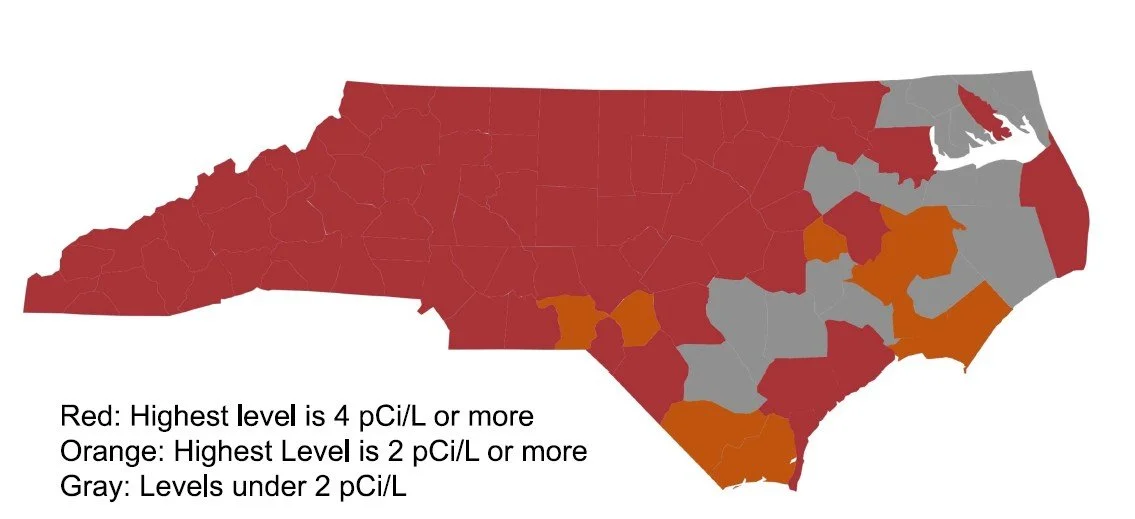
The NCDHHS recommends testing both the air and the water for radon in the counties of: Ashe, Alleghany, Avery, and Yancey - due to the likelihood of high levels of radon in the ground.
Home Owners
If you bought a home through working with me, you’ll know that I highly recommend having the home tested for radon. If I had the power, I would insist!
However, for those of you who built your home or are living in a home you perhaps inherited from family, the chances are good that you’ve never had the home tested for radon. I am suggesting that you do that now.
If you are building a home, I suggest you ask your contractor to include the preliminary work to later install a mitigation system, should your home test above 4 pCi/L once construction is complete. It will be less expensive than installing from scratch afterwards.
Radon Testing
The cost of a radon test is minimal, around $250 depending on whom you hire to run the test. Computer tests that remain in the home for several days are considered the most reliable. [Normal ingress and egress are OK during this time, but windows and doors must otherwise remain closed for the test to be reliable.] You can also purchase an inexpensive charcoal-based test at a building supply store that you can run yourself.
If you would like to have your home tested for radon, I am glad to recommend the companies I have used and whom I find reliable.
LandLords/Ladies
Know that the state of North Carolina requires that your rentals show that radon is not present in your rentals at a level above the 4 pCi/L level.
Mitigation
If your home shows a radon reading higher than 4 pCi/L, you can choose to install a mitigation system to bring the level down within your home.
From the perspective of the overall cost of a home, the cost to mitigate for radon is also minimal: +/- $2000 is a likely cost for most homes.
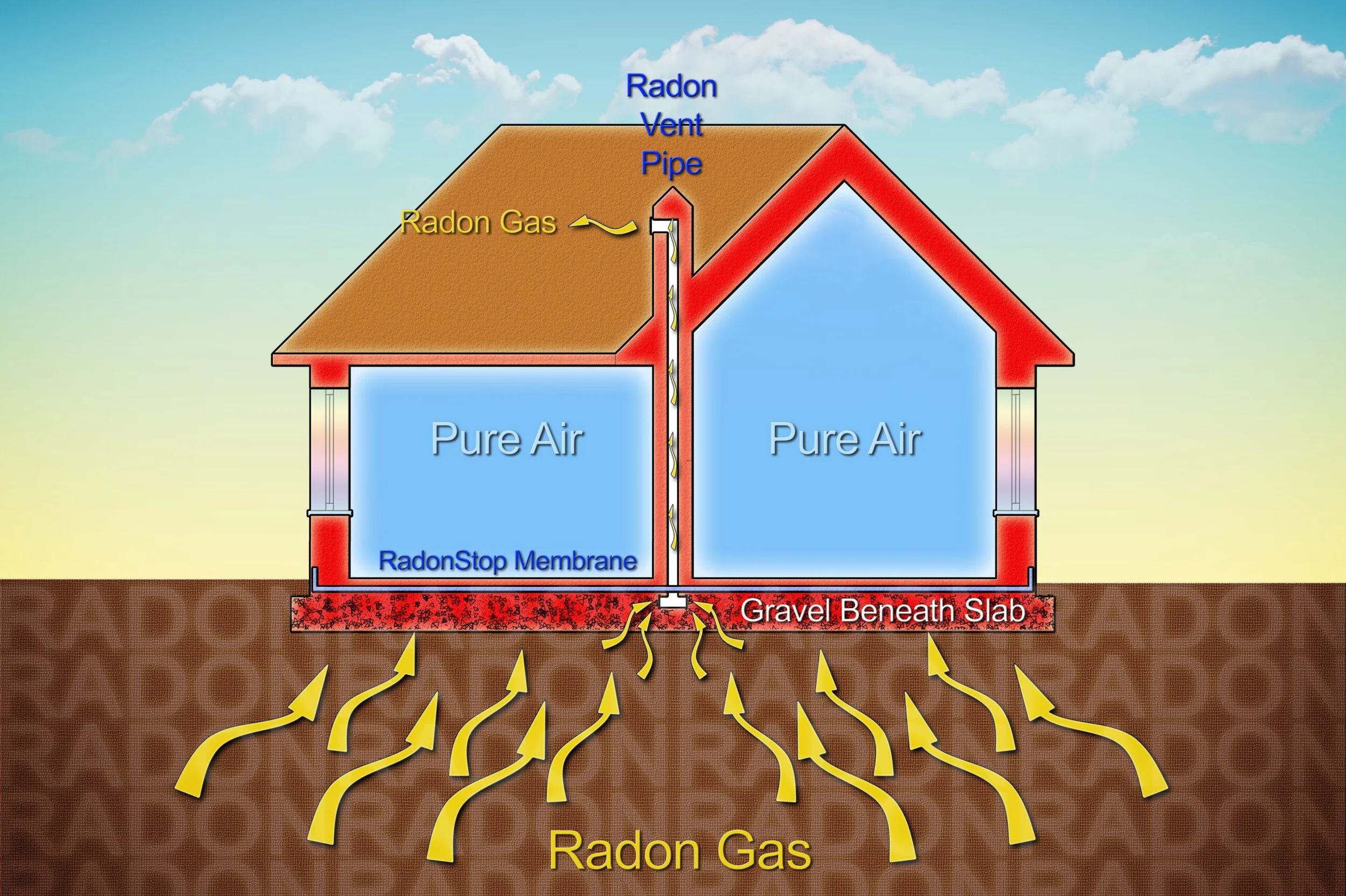
How is a home mitigated for radon? This is a very simplistic explanation, and some types of home construction will require a more complicated system: for most homes, a hole is punched in the slab or crawlspace under the home, a pipe is put through the hole to access the air under the home. The top of the pipe leads outside the home. A motor is installed to gather the air under the home and expel it through the pipe to the outdoors.
After the system is installed, you will want a test run to make sure the system has successfully reduced the radon below 4 pCi/L. In some homes, more than one system must be installed.
Once Tested and Mitigated, Are You Forever Done with Radon Concerns?
No. It is wise to check the amount of radon in your home from time to time.
First, the motor can fail.
Second, the amount of radon coming out of the ground varies; it is not a once and forever steady amount. It could have been a small amount at the time of an initial pre-test or the post-test after installing a system. In the long run, the level in your home the amount may be consistently higher. Testing over time will be the only way to know.
Radon in Water
So far, I have been referring to radon in the air. If the radon level is high in your home, the possibility exists that it is high in your water supply. When you are running water out of a faucet, the radon in the running water can escape into the air in your home. Also, of course, you could ingest it.
It is possible to test the water and also to mitigate the water supply. I have not been involved in completing this process either for myself or a buyer or seller. Once, I was asked to investigate the cost. Both the test and the mitigation of a water supply are very high.
The NCDHHS believes that high levels of radon in water contribute to stomach and bone cancer, as well as kidney distress.
Other Considerations to Keep in Mind:
Approximately 480 North Carolinians die each year from radon-induced lung cancer.
Lung cancer incidence in dogs and cats is approximately 2-fold higher in areas with high radon potential.
Exposure to a high radon level increases the risk of radon-induced lung cancer over time. That makes children growing up in a home with a high level of radon more vulnerable to radon exposure. See the fact sheet linked below for more information on why children are more vulnerable to radon damage.
Exposure to cigarette smoke increases a person’s risk for radon-induced lung cancer.
The information I have stated above comes from the North Carolina Department of Health and Human Services: https://radon.ncdhhs.gov.
They offer much more in depth information on all these topics, as well as:
A basic radon fact sheet in 16 languages
A guidance document created for each of the 100 NC counties
I recommend you to read/view any of these documents that are relevant to your personal concerns about radon. I especially recommend you look at the state’s assessment of the county you live in:
I hope you have found this information to be relevant and helpful. Please let me know if I can address any concerns or questions you have.
Helen L Phillips
Coe Realty Broker/Owner
PO Box 3397, Boone NC 28607
Office/Landline [no texting] 828.264.1434
Cell/Texting 828.964.1601
Helen@HelenLPhillips.com
Copyright 2026